Tutorial

Inspect Document (Advanced File Properties)

In PowerPoint 2007 the document properties are divided into 2 views. Yesterday’s post showed the new properties view that is easy to use, integrated into the user interface and displays the personal information that can be sent out with a presentation.

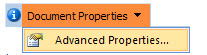
But the ‘old’ file properties are still there. To open, click the DOCUMENT PROPERTIES button in the upper left of the properties ribbon. Now we see the same properties window that has been with PowerPoint for a number of versions.

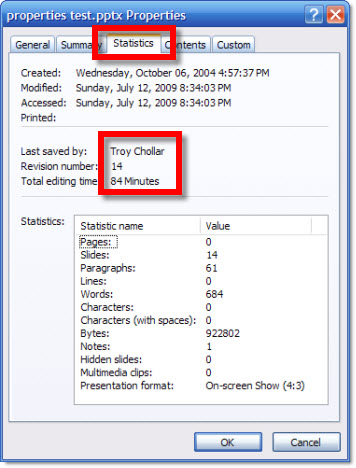
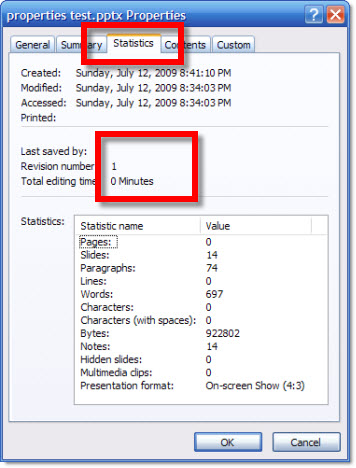
The tab I focus on is the STATISTICS information. And the LAST SAVED BY, REVISION NUMBER, TOTAL EDITING TIME are the information I generally want to clear out.

After clearing the Document properties those 3 things are are all clear!

Finally, if running an earlier version of PowerPoint (eg. XP or 2003) I have used for many years the add-in Shyam’s Toolbox which among its many tools is a clear properties function.

– Troy @ TLC

By |2016-09-16T10:05:41-07:00July 13th, 2009|Tutorial|

Inspect Document (3)

One of the professional touches when distributing a presentation is to verify what, if any, properties information is going out with the presentation. As example, if I developed a presentation for a client I would not want this information in the file properties:

Having my name, company and other information not pertaining to the client would be unprofessional.

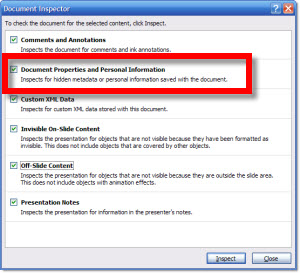
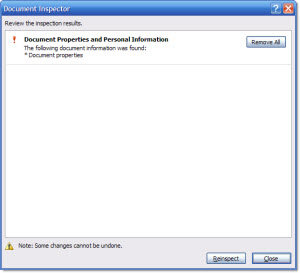
But if I go to Inspect Document, check ‘Document Properties and Personal Information’ and inspect the file:

I am given an information dialog that says there are personal information in the file properties. What it does not do is give you a quick way to open the file properties and see what is there (go to Office Button >> Prepare >> Properties). But it does give me an option to remove the properties information.

Now the file properties are ready for me to add the end client information, or leave completely blank – either is a more professional touch than displaying your personal information.

– Troy @ TLC

By |2016-09-16T10:06:01-07:00July 12th, 2009|Tutorial|

Inspect Document (2)

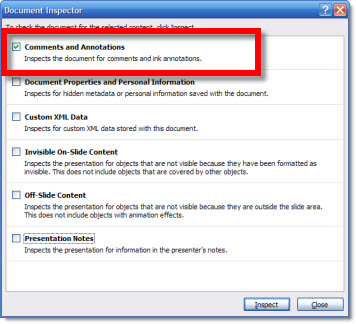
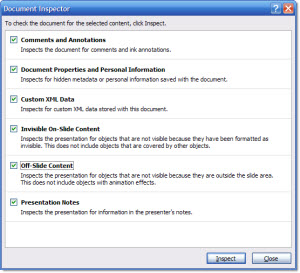
When you open the Inspect Document it has 6 sets of data it will check a presentation for. None are critical, but all offer professional finishing touches to your presentation, especially if it is to be distributed.

– Troy @ TLC

By |2016-09-16T10:06:22-07:00July 10th, 2009|Tutorial|

PowerPoint’s ‘Inspect Document’ Feature

Here is one of the new features that has been overlooked by most. Some of its functions were possible in prevous versions, some were possible using add-ins. So I have a mini-series of posts on what the INSPECT DOCUMENT feature in PPT 2007 can do for you.

To access:
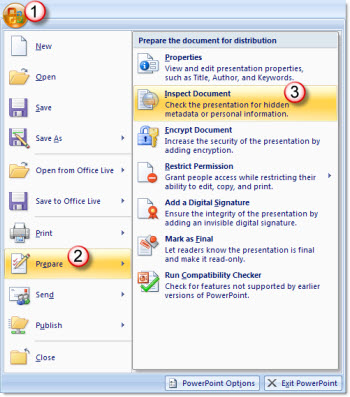
Office Button >> Prepare >> Inspect Document

– Troy @ TLC

By |2016-09-16T10:06:43-07:00July 8th, 2009|Tutorial|

4th July Text

I had a few emails asking about the 4th of July post. I did most of the work in Photoshop compositing the red/white rays with the fireworks. Then in PPT 2007 I added the TLC logo, a radial gradient shape under the logo to help it have contrast and be visible and finally created the text using PPT 2007 gradient fill options.

The text is a custom font (Albert, which is license restricted so not embedded – will default to some other font on your computer…). I added a custom 3 step gradient, bold outline and near opaque drop shadow (needed on the visually busy background used in previous post). The slide can be downloaded here.

– Troy @ TLC

By |2016-09-16T10:07:09-07:00July 6th, 2009|Portfolio, Tutorial|

Difference Between ‘Header/Footer’ and ‘Slide Number’ Buttons

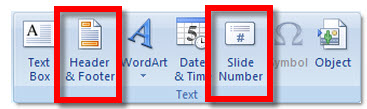
One of the great things about PowerPoint is there is almost always more than one way to do things. And almost always the multiple ways of doing things are found in different areas of the program. But one that can be confusing is the ‘Header/Footer’ and ‘Slide Number’ buttons.

I guess the confusion is that they open the exact same dialog box. They are located on the same tab. And located on the same section.

It does not matter which you use. As example, it’s okay to click the ‘Header/Footer’ button and turn on the page numbering. I believe it is just another example of statistics leading the development process. Statistics probably showed a lot of users (tested or observed) where unaware of how to setup page numbers. The obvious answer was to add an easy to identify button labeled ‘Page Number’ – problem solved.

– Troy @ TLC

By |2016-09-16T10:07:29-07:00July 3rd, 2009|Tutorial|

Clear Text Styles

So you are working in PPT 2007 and enjoying the great design tools like the ability to stylize any text (because all text is WordArt now).

I start with this:

Then we stylize it to look like this:

But later we decide we want it back to standard text – like this:

How do you do that….

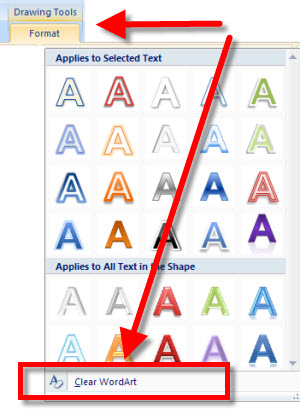
Select the text >> go to the Draw-Format tab >> click the drop down to show the full menu of the preset styles >> at the very bottom is the ‘clear wordart’ option (remember, ALL text is now wordart)

Done!

-Troy @ TLC

By |2016-09-16T10:09:41-07:00June 25th, 2009|Tutorial|

Add ‘dummy’ Text to a Slide fast

Here is a nifty programming trick that can be helpful when you are demoing PowerPoint (as I have been with a number of specialty training programs).

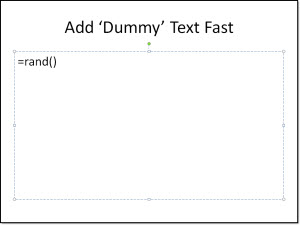
In any text box, in either PPT 2003 or 2007, type this: =rand()
Then Enter/Return.
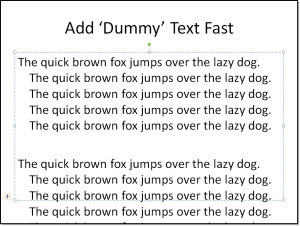
It will automatically be filled with a few paragraphs of “The quick brown fox…”!

– Troy @ TLC

By |2016-09-16T10:12:09-07:00June 11th, 2009|Tutorial|

Ungroup SmartArt!!

With Office 2007’s SP2 installed SmartArt has become a lot more usable/smarter. Now you can use the great diagram templates in SmartArt and ungroup them if needed. Why ungroup? For fine tuning, modifying to meet the slides exact needs, or animating would be a few of my top reasons.

1. Insert SmartArt

2. Ungroup

3. Result is a single box of grouped autoshapes (and the smartart programming for updating text is removed)

4. Ungroup one more time and you have all individual elements

– Troy @ TLC

By |2016-09-16T10:12:29-07:00June 9th, 2009|PowerPoint, Tutorial|
Go to Top