
The 2016 New Chart Types – A Look Back to February 2016
Looking back through previous posts, I read this one highlighting new chart types introduced to PowerPoint back in 2016 (original post here).
Today, of the 4 chart types introduced in 2016, I cannot recall ever using a Radar chart… and maybe 3-4 times the Treemap chart type. I do recall working on a Sunburst chart and using PowerPoint to create the basic chart, then ungrouping -> converting to shapes -> modifying to the custom styling & sizing needed -> and then producing a fantastic animated series. End result was great, it all started with a native PowerPoint chart. But 4 hours later, it was all custom art elements.
Question: thinking back to 2016, how often do you use these 4 chart types?
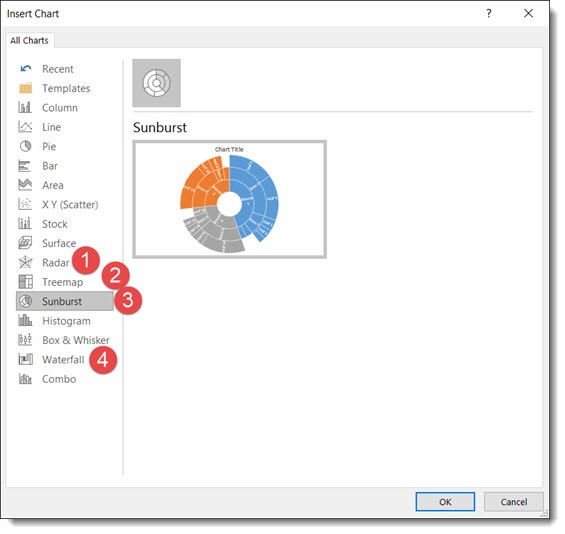
How to insert New Chart Types in PowerPoint 2016
New Chart Types where added in PowerPoint 2016. There is bigger news than just some new styles. Microsoft is moving all charting to a new charting engine, and these new charts are coded with this new engine. Eventually, all legacy charts will be ported to the new charting engine, and, fortunately, this is still an in-process engine development (I am certain everyone will encounter a chart limitation depending on their chart data and the way they create charts) – so my take on things is “Yay new charts! But the new charting engine is not fully functional, so some options in the new charts are not fully functional yet.”
The good news is even though only subscription users can create these charts, all versions of PowerPoint (dating back to 2010 and Mac versions) can display chart types – editing and animation is somewhat limited when using previous versions…
Here are 4 of the new chart types currently available (we will continue to see more chart variations added over time, look for another new chart type in the February updates).
Follow these Steps:
Go to INSERT > CHART
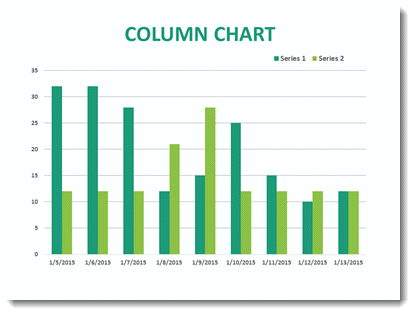
The Column Bar Chart
A standard Chart.
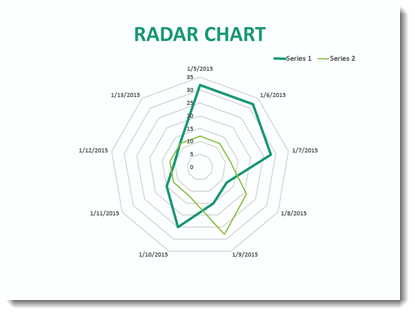
1. Radar Chart
That same data in the Bar Chart can instantly be updated.
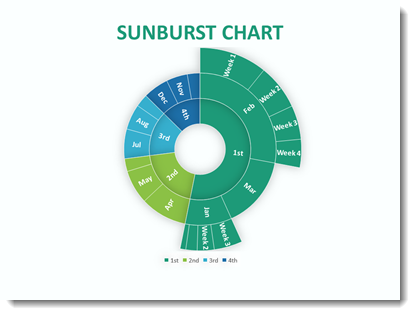
2. Sunburst Chart
This a great addition to the native PowerPoint chart options vs. going to external charting apps to develop.
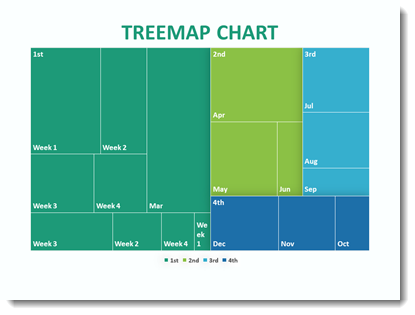
3. Treemap Chart
This Chart is new to PowerPoint 2016 native chart options.
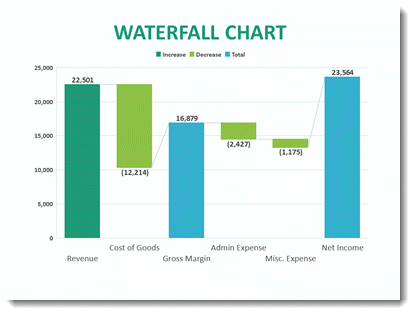
4. Waterfall Chart
This standard Column chart with negative data.
-Troy @ TLC
This is from our Look Back series, rediscovering previous blog posts with relevant PowerPoint tips, tricks and examples. The original post from February 17th, 2016 can be viewed here.
Is My Chart Too Skinny?

If you’ve ever inserted a bar chart into PowerPoint and thought that the bars look too thin and awkwardly spaced — you’re not alone. The styling solution is available within PowerPoint, let’s walk through adjusting the bar thickness, and reducing that gap between bars.
1: Select Your Chart

Click on the chart to make sure it’s selected. Once it is, you’ll see the Chart Tools menu pop up at the top with two tabs: Design and Format. Along with the Format Data Series option, these are your go-to tabs for making all the visual adjustments you need.
2: Format the Data Series

To start adjusting your chart, right-click on one of the bars and select Format Data Series from the dropdown menu. This will bring up a panel on the right side of your screen, where you’ll find various options for fine-tuning your chart.
3: Adjust the Gap Width

Within the Format Data Series panel, navigate to Series Options. Here, you’ll find the Gap Width slider, which controls the width or height or your bars. Reducing the Gap Width will make the bars skinny. Increasing the Gap fattens them up. This step will also reduce (or increase) the gap between each of the series bars. In the two examples shown, notice the gap in the between the Black Cars and Green Cars. Play with the slider and adjust it based on your preferences.

4: Adjust the Overlap

If you’re working with a clustered bar chart, you might also want to tweak the Series Overlap setting, located just below the Gap Width slider. Increasing the overlap percentage will cause the bars to slightly overlap, while decreasing it will add more separation. A range of 0% to 20% usually works well, but adjust as needed for your design.

5: Fine-Tune and Customize
Once your bars are spaced to your liking, it’s time to add those finishing touches. Experiment with colors, add data labels, or remove gridlines for a cleaner look. You can do all of this from the Chart Elements button or through the Chart Design tab. Little tweaks like these can make a big difference in how professional and polished your chart looks.
Bonus Tip
If your bars still aren’t quite right, try resizing the chart by dragging its edges. Sometimes a wider or taller chart gives those bars the breathing room they need to stand out. Adjusting the size can be an easy fix for better proportions.
And that’s it! Now your bars should look bold, clear, and way more polished. It’s all about finding that sweet spot with the gap width and overlap.
Adjust The Chart Size… Inside the Chart Frame!
There is a secret when it comes to PowerPoint charts (bar charts, line charts, pie charts, etc.) The secret is: charts have two elements for sizing; the overall chart element bounding box (or frame), and inside that the chart bounding box.

Keep the chart’s overall size as is, which can be helpful for alignment on a slide, or when multiple charts are on a slide. Click the chart, then click the data to make the inner bounding box active. Resize and position as needed – within the outer bounding box of course!

The same goes for chart and axis titles and legends. Each is resizable and moveable within the overall chart bounding box.
TIP: use the legend preset location options; top, bottom, left, right to adjust all chart elements positions, then fine tune the legend size and position).

The functionality is there. It is finnicky. And now it is no longer a secret, hidden formatting option!
-The TLC Creative design team
Chart Tip from 2008 that is Still Relevant Today! – A Look Back to November 2008
TLC Creative’s theme for April is “PowerPoint charts”. And that had me looking way, way back to our past blog posts. Back in 2008 (17 years ago!) this posts contains tips to overcome the common frustration of “I edited the chart, but need the original version.”
The original post from November 3, 2008 is here.
—
For many projects I find myself ungrouping charts for custom animation or any number of other reasons. But what often happens is there is need to adjust the chart… oops it is now 50+ individual text boxes and autoshapes.
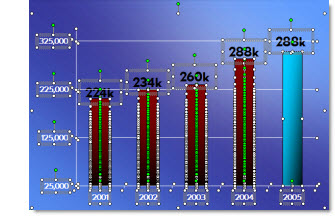
My solution is before I break apart a chart is to create a duplicate it.
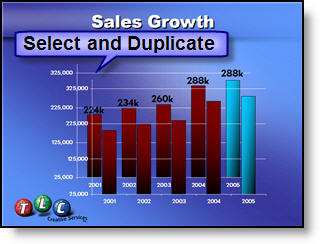
Then shrink the duplicate to a miniature size.
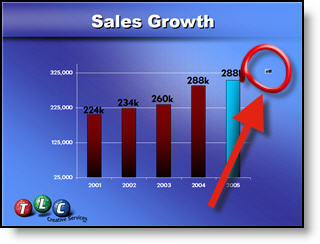
I then move the miniature version off the slide so it is not seen during a slide show (or I have also ‘hidden’ it under another graphic).
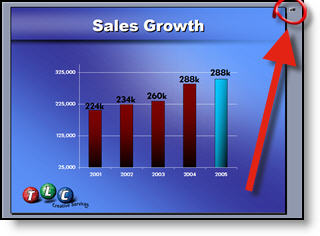
Now I can ungroup the chart on the slide and do whatever the special needs are – and still have a backup option should the data need to be adjusted.
– Troy @ TLC
This is from our Look Back series, rediscovering previous blog posts with relevant PowerPoint tips, tricks and examples. The original post from November 3rd, 2008 can be viewed here.
New podcast episode available! “Exploring Canva’s Presentation Power: A Conversation with Dani Watkins”
A new episode of The Presentation Podcast now available!
Have you wondered how Canva’s presentation features stack up against PowerPoint? This podcast episode we have enlightening chat with Dani Watkins, a “Canvassador” about all things Canva and Canva Presentation! Dani shared how Canva’s user-friendly interface and extensive design options have transformed her approach to presentation design.
From repurposing graphics across various formats to the seamless remote sharing capabilities. Plus, did you know Canva now offers offline capabilities for presentations? We didn’t either, but Dani gets us up to speed with Canva Presentation’s latest offerings.
Listen on your favorite podcast app, or at The Presentation Podcast site here.
Microsoft MVP Summit 2025
Last week Microsoft held their annual “MVP Summit”, an invite only event on the Redmond, WA campus. As an awarded MVP for PowerPoint, I was on the invite list and ventured up to the Microsoft campus for several meetings and information sessions with the PowerPoint Program Managers hearing about, and discussing, future features. All content is under NDA, but I can say, several updates to PowerPoint are releasing soon – and the focus for every group within Microsoft is AI and Microsoft Copilot integration and features.

A few stats on the Microsoft MVP program:
- First, I have been annually awarded as an MVP for PowerPoint since 2004! It is a huge privilege and honor that is one of my career highlights (and my Microsoft MVP profile is is here).
- The Microsoft Most Valuable Professionals (MVP) program recognizes exceptional community leaders for their technical expertise, leadership, speaking experience, online influence, and commitment to solving real-world problems. MVPs are individuals who share their knowledge and influence Microsoft products and services.
- The MVP program benefits to awarded individuals is primarily direct communication with Microsoft teams, a voice in directing program development, early access to Microsoft products, and recognition for their contributions. For me is it really the opportunity to collaborate with the PMs and developers to give real-world feedback on how PowerPoint is used, the pain points of use, and brainstorm ideas on what would make it a better tool for presentations.
- Last, there are not many of us; 15 Microsoft MVPs for PowerPoint in North America (U.S. and Canada) and ~35 worldwide.
Troy @ TLC
A Look Back to PowerPoint Kerning in December 2007
Design principles do not change, and text formatting rules, such as Kerning, remain constant. If there is one huge observation the TLC Creative design team all noted, it was that Kerning controls in PowerPoint have not improved in over 15 years! Here is the post from December 2, 2007 that (unfortunately) has the same interface and options in PowerPoint in 2025…
—
If you have used desktop publishing software you are familiar with the concept of kerning. With (variable width) fonts, different pairs of characters are spaced differently. Kerning is the adjustment of spacing between letters to obtain a more pleasing appearance. The great news is that PowerPoint now has some basic kerning capabilities. Microsoft calls it ‘Character Spacing’ and here is the quick menu.
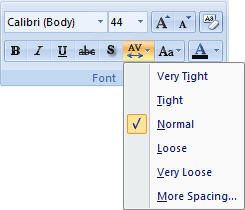
We can also get more fine control over the Character Spacing by opening the Character Spacing dialog window.
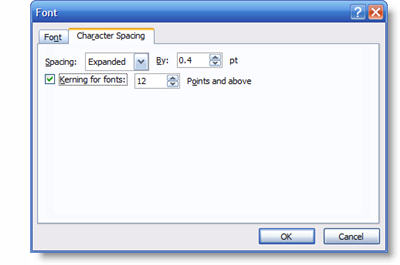
Here are a few examples of kerning in use. The top text is the standard, or normal, kerning. The second one is expanded and the third is condensed. All is still editable text and can be applied to select text within a single text box.

– Troy @ TLC
This is from our Look Back series, rediscovering previous blog posts with relevant PowerPoint tips, tricks and examples. The original post from December 3rd, 2007 can be viewed here.