The PowerPoint® Blog

I work with PowerPoint on a daily basis and I am very honored to be a Microsoft PowerPoint MVP. We have a talented team of presentation designers at TLC Creative Services and ThePowerPointBlog is our area to highlight PowerPoint tips, tricks, examples and tutorials. Enjoy! Troy Chollar

Gradient Circle Fill Effect

I have been experimenting with gradient fills for a recent project. First, the gradient tool in PPT 2010 is great! It still has some usability issues, but overall it is easy to use and has a lot of flexibility. Here is one effect I developed and below is a link to download a slide with the gradient shape.

1. Start with an oval. No outline and any fill.

2. After applying a custom gradient fill here is the result.

3. To create the gradient fill I adjusted 5 elements:
1. Open the FORMAT SHAPE dialog, go to the FILL section and for fill type choose GRADIENT FILL
2. Change the type of gradient to PATH
3. Make the far left color black. Slide to position of 10-15%. Transparency = 0% (solid black).
4. Move second color to right side at position of 80%. Make color white, or change Brightness to 100% (white) and set Transparency to 100% (no fill).
5. Add a third color bar/stop even further to the right at position of 95%. Make color white (or set brightness to 100% to change any color to white) and make it slightly transparent with Transparency at 25%.

4. Now position gradient cirle under any object for a bit of perspective.

5. Because the shape was created with transparency, it can go onto any color background.

Download slide with gradient shape here (35K).

– Troy @ TLC

By |2016-05-04T09:45:29-07:00October 11th, 2010|Tutorial|

Where Have You Been Lately…

Sometimes projects and life just get a bit out of hand. Well I spent the past month developing graphics for a large meeting and the past week on showsite. The great news is the show was awesome. The better news is that after 4 days of non-sleep I am back, sleeping long hours and able to work on this month’s posts!

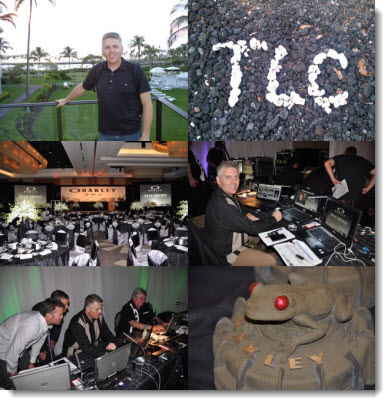
Here are a few pictures from the show:

Top: my work area. Fairly simple show from a graphics perspective, single wide screen High Def (1900×1080) presentation. So two show computers (primary and backup), work computer, network, some peripheral equipment and the all-important script book with every presentation cue.

Middle: stage. It was a really, really big widescreen presentation at 60 feet wide x 40 feet tall (that is a real car on stage for perspective).

Bottom: show had a crew over 100 people and communication is critical. These are just the wireless ‘com’ units (most shows has lots of wired headsets and maybe 3-4-10 wireless, this show had 30+ wireless)

By |2016-08-16T11:02:52-07:00October 7th, 2010|Personal|

Movie Length When Trimming

PPT 2010 has added lots of very good video editing tools. In working on a recent project with many videos I happily made use of the Trim feature to set custom start/stop times. But after using a calculator to figure the new section duration (for over an hour), I discovered a new function!

Here is my sample video freshly inserted. The End Time shows the duration of the whole video.

Here is the sample video with custom start and stop times setup. Note the upper right corner where PPT is smart enough to automatically calculate and display the new duration of the video (yeah!)

– Troy @ TLC
By |2016-08-16T11:03:11-07:00September 28th, 2010|Tutorial|

Lance Armstrong Animated Slide

People ask all kinds of questions about slides created. If it is a cool topic like this one, Lance Armstrong, I hear “Wow, that is really awesome to work on stuff like that.” But the comment about the same slide from the client is usually, “How long did it take to create that really awesome slide…”. Just depends on your perspective.

But this was an awesome slide to have the opportunity to develop for a presentation. Awesome subject. Awesome photography. Awesome animation. Here is the image preparation needed in Photoshop:

1. Original Photo

2. Drop out background and have just Lance Armstrong

3. Make background without Lance Armstrong

4. Create motion streaks of Lance Armstrong speeding away (key for the animation)

5. Create semi-transparent background image

Here is what it took to create the animated slide:

1. start with opaque background image and .png image of Lance Armstrong (looks like original)

2. Fade in the motion streaks .png image

3. Grow/shrink and slight motion path on Lance Armstrong image and motion streaks. Fade out opaque background and fade in semi transparent background

4. Done. Total billable time – few hours. Result – (hopefully) audience wow.

– Troy @ TLC

By |2016-08-16T11:03:56-07:00September 23rd, 2010|Tutorial|

Automatically Insert ‘Real’ Lorem Ipsum Text

And there is more!!

In the previous posts we used the secret coding that has been in PowerPoint since at least PPT 2003. With Office 2007, Word got an update to the coding – but not PowerPoint. But in PPT 2010 the update is included! That is to change the typed code to “=lorem()” and get a real “Lorem ipsum dolor sit amet…” text.

Here is my sample slide again, but now the “rand” is replaced with “lorem”.

Click the enter key and I get 3 paragraphs of real lorem ipsum text (note each paragraph is unique text):

But the ability to customize the number of paragraphs and lines per paragraph detailed in the previous post is not available using the ‘lorem’ option… Maybe in the next version.

– Troy @ TLC

By |2016-08-16T11:04:52-07:00September 20th, 2010|Tutorial|

Customize The PPT Auto Lorem Ipsum Text

But wait, there’s more!

In addition to the secret code shown in the previous post, you can add parameters to control how many paragraphs of sample text – and how many lines per paragraph.

Here is my sample slide, I have have added the parameters to insert 3 paragraphs of 2 lines each with “=rand(3,2)“.

Just click the enter key and it turns into this (3 paragraphs of 2 lines each):

– Troy @ TLC

By |2016-08-16T11:05:27-07:00September 18th, 2010|Tutorial|

Auto Lorem Ipsum Text

This is a cool and useful trick that has been in PowerPoint for a few versions. It is good for creating quick sample slides. Basically there is a bit of hidden code in PowerPoint that you can activate by typing “=rand()“.

Here is my sample slide (default PPT template) and I have typed the ‘secret’ coding.

Then press enter and it fills the text box (and beyond) with “The quick brown fox…” text.

– Troy @ TLC

By |2016-08-16T11:05:42-07:00September 16th, 2010|Tutorial|

Free PowerPoint Files.com Review

The Free PowerPoint Files website is a collection of PowerPoint templates. It looks to be a companion site to the “PowerPoint Styles” website I reviewed back in June offering the same template designs. Free PowerPoint Files offers several hundred PowerPoint templates that are image based with stock images for the background and text placeholders formatted to coordinate with the background image.

The templates are all the legacy .ppt format. But they are free. What you download is a nice background image, but not a very functional template. The images used for the template backgrounds are very modern and work well for templates. When I opened the template I downloaded it looked good from the thumbnail view with multiple layouts and PowerPoint placeholders positioned well on the background image.

But the Title slide (viewed in edit view, not master slide view) showed a single text box vs. separate text boxes for the title and subtitle text, which have different formatting. And the background was a placed .jpg (eg. not from a preset master slide).

The Master Slides revealed no formatting, just a placed .jpg for the background. No text placeholders, named master, title slide master, etc.

If you are familiar with the basics of setting up templates with default placeholders, color scheme and transitions the PowerPoint Styles templates offer nice backgrounds to start with.

– Troy @ TLC

By |2016-08-16T11:06:16-07:00September 12th, 2010|Resource/Misc|

Apply “Sharpen” to Images

PPT 2010 has lots of great Photoshop-like effects built into the application. This post is highlighting the SHARPEN AND SOFTEN filter in a real-world situation.

Here is my original image.

Here is the effects applied to stylize the image (rounded corners, bevel, reflection, etc.). All looks great, but look at the face – it is not as crisp and defined.

With the image selected go to FORMAT >> ADJUST section >> CORRECTIONS

Looking at the top row is the SHARPEN AND SOFTEN quick options. The highlighted box shows what is currently applied to the image. I am going to click and apply the far right option which is a much greater sharpen filter.

Here is the same image, same stylizing effects, but with the greater sharpen filter setting. The bevel is there, the reflection is there and the face is super crisp.

– Troy @ TLC

By |2016-08-16T11:06:32-07:00September 10th, 2010|Tutorial|
Go to Top