powerpoint

Zebra on Wheel’s Add-in Review

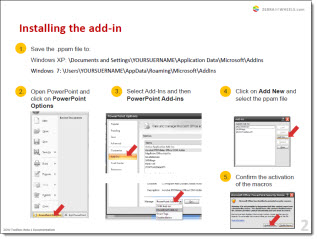
The Zebra on Wheel’s Toolbar add-in is available for free for PPT 2007 and above.

When you download, you get a zipped folder with the add-in as well as a PDF that explains which folder on your computer to put it, and what to do in PowerPoint to add the add-in to your ribbon. Note: To download, you need to give your name, e-mail address, and agree to a disclaimer.
Zebra on Wheel’s adds a new Toolbar to the ribbon:

Tools added are:
Fix Title: Resets the title of the current slide to the template’s default position.
Template Bullets: Applies the template’s bullets to an existing text.
Select by Property: Selects objects using the same color, font and other properties.
Copy Property: Copy height, width, position, fill color, etc. from one object to others.
Graph Data: Extracts data table from unlinked/broken graphs.
Cell Colors: Copy/pastes table cell colors.
Merge Text: Merges the text content from different objects.
Hex Color: Uses web-style hex colors.
Explore: Opens the folder containing the current file in a Windows Explorer window.

Examples of some tools in use:

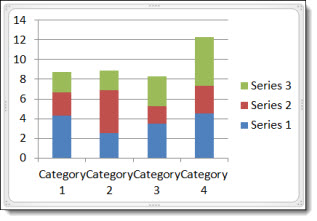
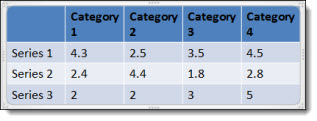
Graph Data: This add-in will pull data from charts and put it into a table. The description says it will work on unlinked and broken graphs, which could really come in handy! However, when I tried it on a broken graph an error popped up and no table was created. I inserted a new graph with the default values and the add-in produced a table with the data extracted. This is nice, but would have been nicer to have the data pulled from broken graphs as stated.
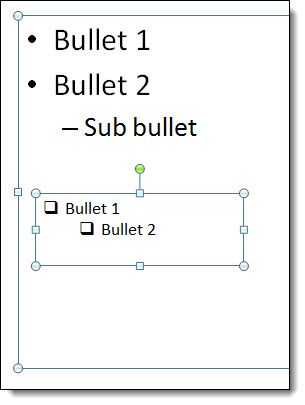
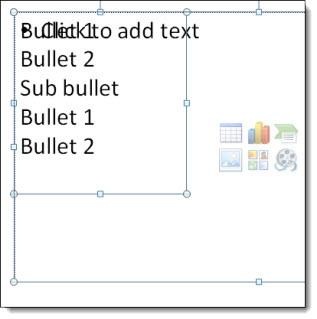
Merge Text: This add-in will take two text boxes and merge them into a single text box. I used the content placeholder and an inserted text box and hit the merge text add-in. It took the text and put them in a text box that wasn’t the placeholder, and completely disregarded the bullets and sub-bullets that were in place. (I tried merging by having the content placeholder selected first and the text box selected first, both yielded the same results. I would like this better if the bullets stayed intact.
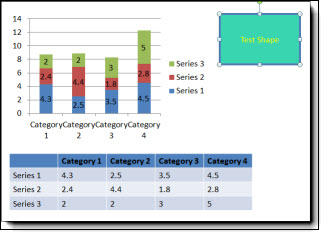
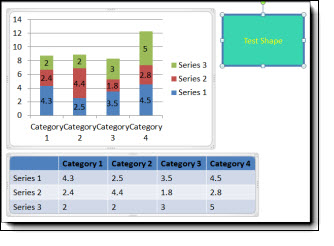
Select by Property: This one is pretty cool and works as expected. I created a test shape on the slide with my chart and table. The only thing they had in common was the font. I selected my test shape and did select by line color, nothing happened as I thought. Then I selected by font name and all three objects on the slide were selected. This particular tools is very nice and has lots of time saving use.
– Amber @ TLC
By |2016-08-16T09:02:01-07:00October 22nd, 2012|Software/Add-Ins|

Auto Scaling Charts and Font Issues

Sometimes features go missing in newer versions of software. In PowerPoint, the “AUTO SCALE” feature for chart text disappeared after PPT 2003.

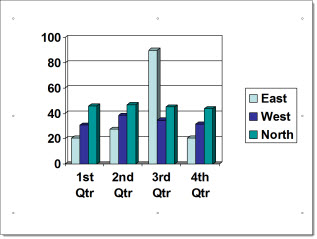
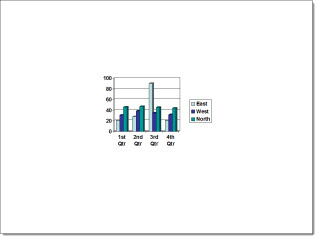
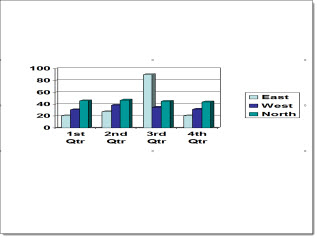
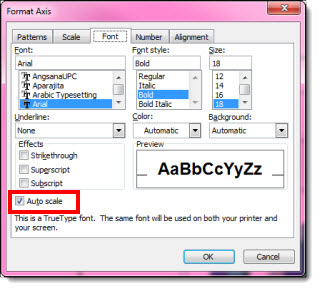
Charts in PPT 2003 have an Auto Scale font feature for chart axis’ (checked on by default) that allows the font to scale to the chart when the chart is resized.

The font stays in scale to the chart when the chart is enlarged or reduced in size.

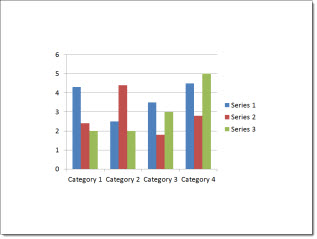
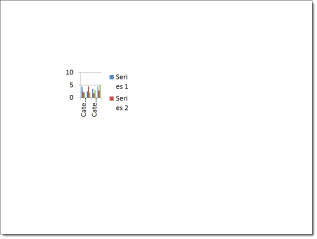
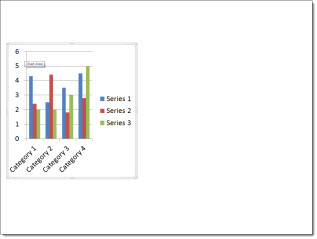
Charts in PPT 2010 do not have the auto scale font feature. When the charts are resized, the fonts stay the same size and get cut off or removed. You have to select the axis and increase or decrease the font manually.

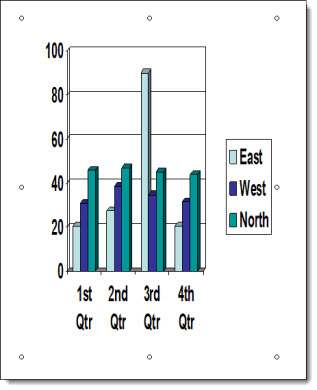
In PPT 2003, however, when the lock aspect ratio for the chart is turned off, and the chart is stretched, the chart becomes distorted.

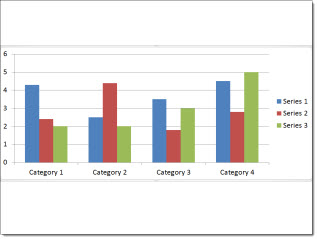
But in PPT 2010, when the charts are stretched horizontally or vertically, they do not distort.

AUTO SCALE, we miss you!

– Troy @ TLC
By |2016-08-16T09:02:23-07:00October 19th, 2012|PowerPoint, Resource/Misc|

Insert YouTube Video Into PowerPoint

PowerPoint 2010 added a new insert video feature that allows online YouTube videos to be added to presentations. I have not recommended this feature because it has the downside of needing to be online and also a high bandwidth connection to play the video. There are several easy ways to download and embed YouTube videos, which I would recommend to minimize playback issues.

But, the request comes up often enough on how to use it, so here is a step-by-step tutorial.

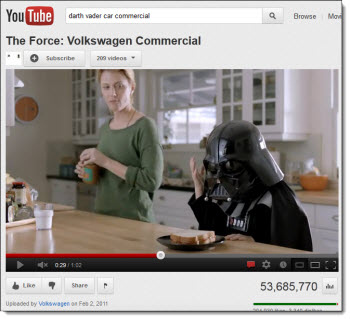
1. Find video you want to insert onto slide.

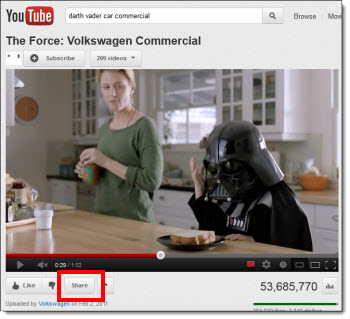
2. Click the “Share” button under the playback bar.

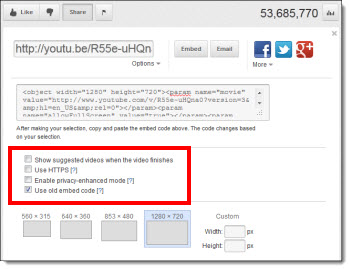
3. Check the “Use old embed code” box. (Uncheck the “Show suggested videos when video finishes” if you want just a black screen when playback is done.) Copy the code.

4. In PPT, go to the Insert tab, and under Media, click the carrot down on the Video button.

5. Select the “Video from Web Site” option.

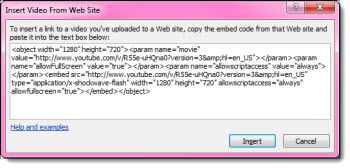
6. Paste the code into the text box. Hit Insert.

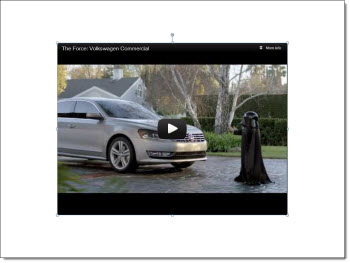
7. You now have the YouTube video on your slide.

Note: As mentioned above, the computer must be connected to the internet for the video to play.

– Troy @ TLC
By |2016-08-16T09:03:02-07:00October 15th, 2012|Tutorial|

PowerPoint vs. Photoshop Opacity Settings

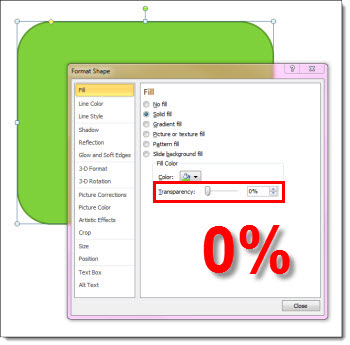
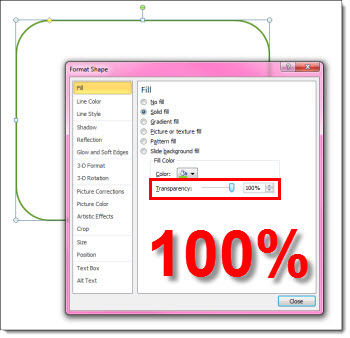
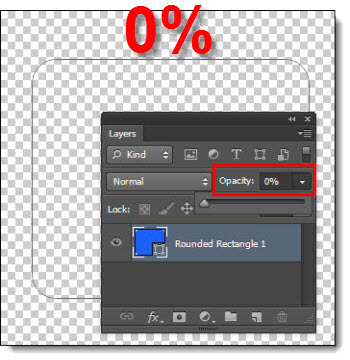
PowerPoint and Photoshop each have their own way of changing the opacity of an element. The most confusing aspect is that each app defines 0% transparency different.

In PowerPoint, 0% Transparency means the shape is fully opaque/solid.

In PowerPoint, 100% Transparency means the shape is fully transparent/invisible.

On the other hand, Photoshop does the exact opposite.

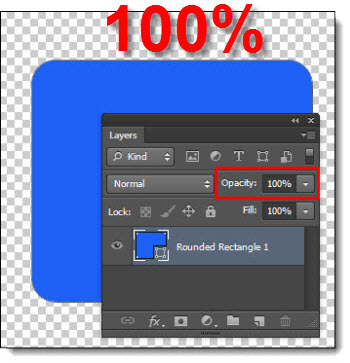
In PhotoShop with 0% Transparency the shape is fully transparent/invisible.

In PhotoShop, 100% with Transparency the shape is fully opaque/solid.

– Troy @ TLC

By |2016-08-16T09:06:52-07:00September 24th, 2012|Tutorial|

PPT 2013 – Improved Presenter Notes

Okay, the title is a bit misleading for this one. It is not so much the presenter notes that are improved, but rather the way you open/close the presenter notes.

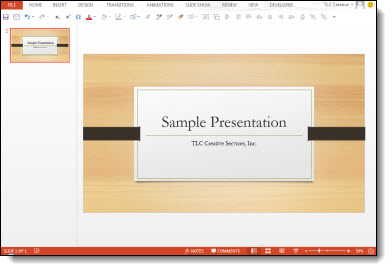
Here is my sample slide, which is not showing the Presenter Notes:

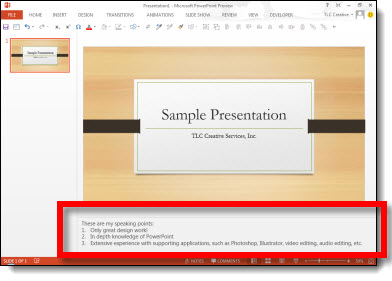
New in PPT 2013 is the addition of a NOTES button on the bottom of the UI.

Click the NOTES button and the Presenter Notes open – no need to fiddle with positioning the cursor and getting the double arrow cursor so you can click and drag to raise up and open the Presenter Notes.

Here is a video of the NOTES button in action
[youtube src=”https://youtube.com/embed/pr5op_ibccE?rel=0″]

– Troy @ TLC
By |2016-08-16T09:10:22-07:00August 31st, 2012|PowerPoint|

PPT 2013 – Resume Viewing When Reopening Presentation

This is a nice addition to PowerPoint and a really well planned and implemented function – Resume.

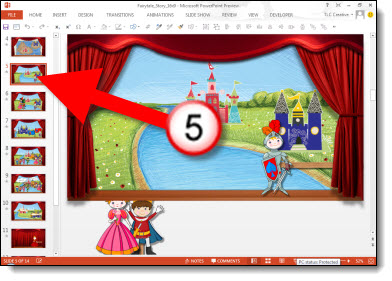
Here is a presentation for a recent project. Note it has 14 slides.

Before closing the presentation, I am on slide #5.

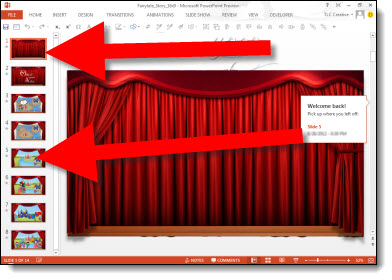
When I reopen the presentation:
1. I am always viewing slide #1.
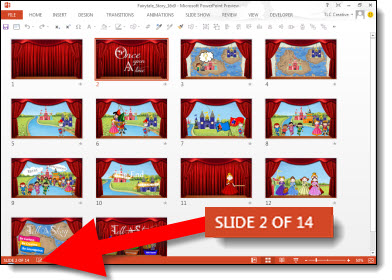
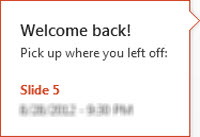
2. I have a message on the scroll bar informing me of the last slide I was looking at before the presentation was closed, along with the date and time.

I can choose to work on slide 1, manually go to any slide in the deck, or click the RESUME box and automatically be taken to that slide – in this case, slide #5

– Troy @ TLC

By |2016-06-23T13:56:26-07:00August 29th, 2012|PowerPoint|

PPT 2013 – Shape Combine Tools

PowerPoint 2007 improved the shape edit tools – ie. Bezier lines (see this Aug. 2009 blog post). While not perfect and very simple – compared to “real” vector editing applications like Adobe Illustrator – they were a great addition to PowerPoint and made lots of design needs available inside PowerPoint.

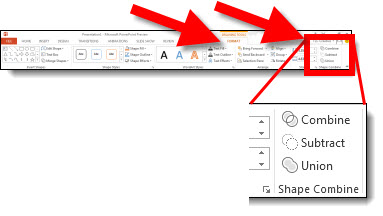
PowerPoint 2010 added another shape edit toolset called “Combine Shape.” They were a great move forward in developing custom vector images inside PowerPoint. But, the real issue was no one knew the tools were there as you had to manually add them to the ribbon. For PowerPoint 2013, Microsoft has “surfaced the feature” – which means it is now on the ribbon by default.

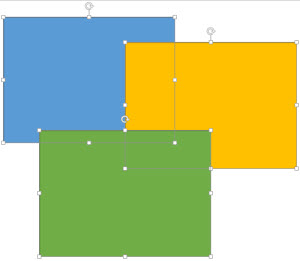
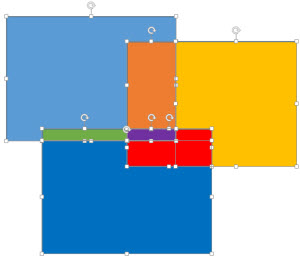
But the default ribbon tools in the “Shape Combine” section do not offer all of the tools – including a new feature that is great! Here is my sample slide with 3 rectangles.

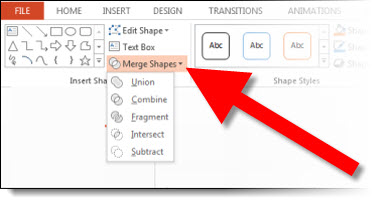
I am going to access the Shape Combine tools using the MERGE SHAPES drop down menu on the Format tab.

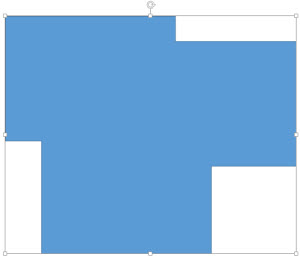
First up is the UNION tool, which takes all 3 selected shapes and creates 1 custom shape (Note: The blue shape was the first selected, so the new shape uses its styling):

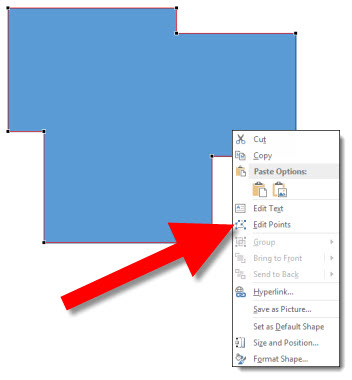
When you edit this new shape, each corner is editable over the single custom shape:

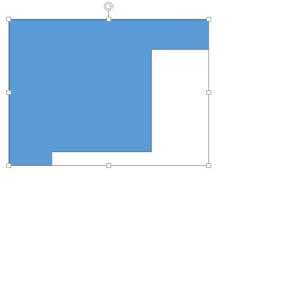
Second option in the MERGE SHAPES is the COMBINE tool. This is 1 shape again, but identifies the overlapping sections and knocks them out to create a unique shape:

Again, when you edit this shape with the EDIT POINTS, it is a single image, with each corner an editable point – and a few unusual edit points:

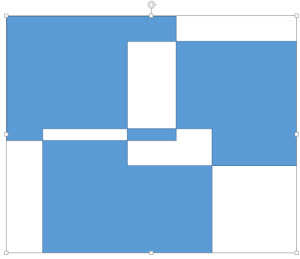
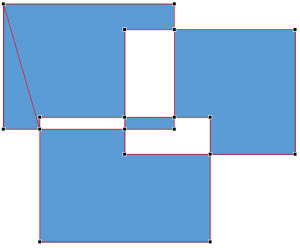
Third in the menu is something new – FRAGMENT. This has some real power and will eliminate many trips to Adobe Illustrator or lots of time using PowerPoint’s Edit Points tool to create custom shapes. Every overlapping section becomes a unique shape. I quickly selected each and added different fill colors for each to make it easy to see the result.

INTERSECT is next and it identifies the overlapping sections where all selected shapes overlap and removes all but the overlap:

And last in the Merge Shapes menu is SUBTRACT which again identifies all of the overlap sections and based on the first shape selected deletes the overlaps:

So if you did not know of the Shape Combine tools in PPT 2010, or if you have used them and now are excited about the FRAGMENT tool, PowerPoint 2013 is certain to prove more powerful in creating custom shapes!

– Troy @ TLC
By |2016-08-16T09:11:36-07:00August 27th, 2012|PowerPoint|

PPT 2013 – Datasheet is Back!

I admit, I am not a number person. That also means I am not an Excel person. So when PPT 2007 came out and the simple Datasheet editing of chart data was replaced with a full Excel experience, I was not the happiest designer in the building. Of course, in the long run, it has forced me to face Excel much more and become much more proficient with it.

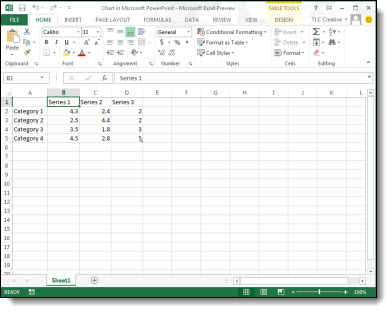
Now, with PPT 2013, it the best of the old and new! Insert or edit a chart and PowerPoint offers the nice, simple and easy to use Datasheet.

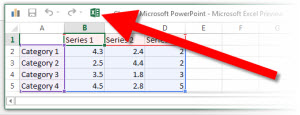
But this is not the Datasheet of old. It is more like Excel Lite, as it is not an independent application like the legacy version, but a simplified Excel editing window. So, if you love Excel, or need more functions than the Datasheet offers, just click the Excel icon.

Now the chart data is being edited in the full Excel experience.

– Troy @ TLC

By |2016-08-16T09:12:38-07:00August 24th, 2012|PowerPoint|

PPT 2013 – Comments

Comments, notes from a reviewer to the presenter or presentation designer, have been a feature of PowerPoint for several versions. With PPT13, the comments interface gets a makeover and greatly enhances their usability.

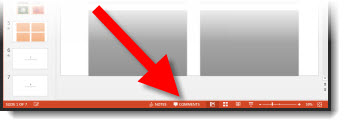
Along the bottom of the UI is a new “Comments” button.

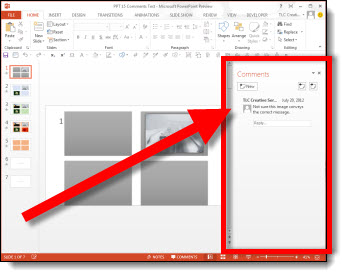
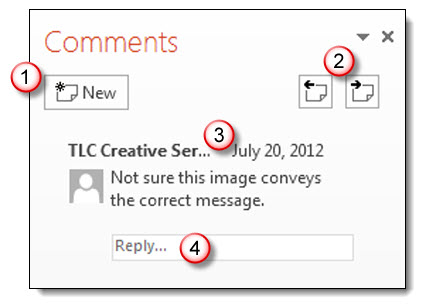
Click the “Comments” button and a new information pane opens that is a central information area for all comments in the presentation.

1. Add a new comment to a slide with this button.
2. To go to the previous or next comment use these buttons. This will automatically jump slides as needed.
3. Each comment shows who authored the comment, the date/time it was added, their comment and if they are a contact in your Outlook or Lync with an avatar – it will also show.
4. Reply direct to a comment in the Comments pane.

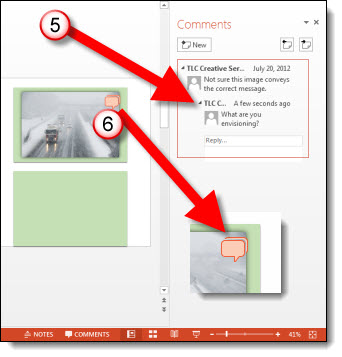
5. Each comment will show all replies. In addition, the onslide indicator (which is only visible while editing the slides and hidden from view during slide show) stacks to show multiple answers.

The ribbon also has a new section with the Comments tools, all of which can be accessed through the comments pane.

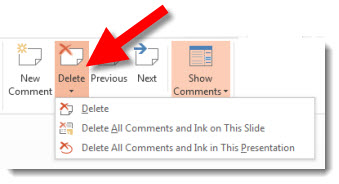
To remove/delete a comment, there are lots of options:
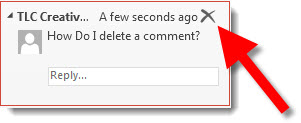
– Click the X next to the comment.
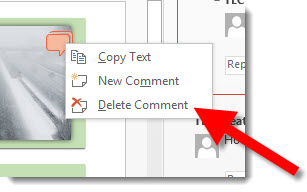
– Right-click the comments icons and select delete.
– On the ribbon in the Comments section, select delete.

I feel this is a great usability advancement for the tool and will go a long way in making this a more common use tool. Also, the comments work in legacy versions (PPT 2010, 2007, 2003) with no problem – but without the new Comnents Pane.

– Troy @ TLC

By |2016-08-16T09:12:56-07:00August 22nd, 2012|PowerPoint|

PPT 2013 – ClipArt is Gone!

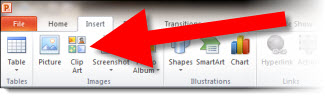
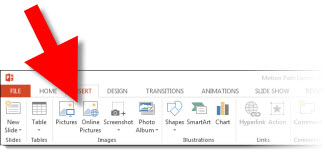
The long use name “ClipArt” can easily be argued that it has outlived is namesake. ClipArt has me imagining simple, flat, and generally bad vector images. So, with that image in our mind, it is often difficult to click the INSERT CLIPART button in PowerPoint 2010.

PPT 2013 has progressed and the “Insert ClipArt” button has been replaced with “ONLINE PICTURES”

The “Online Pictures” button brings up a new dialog. The “Office.com” search goes to the same image catalog as the previous “Insert Clipart” function. The Bing Image Search is a nice addition to have work directly in PPT. And the options can be customized to your workflow. The Public Beta links to a Skydrive account, Office 365 account, Flickr – and the future should offer us many more options as third party companies add the coding to tie in with Office 2013!

– Troy @ TLC

By |2016-08-16T09:13:26-07:00August 20th, 2012|PowerPoint|
Go to Top