Tutorial

PPT 2010 – Is My Video Going To Be Embedded or Linked?

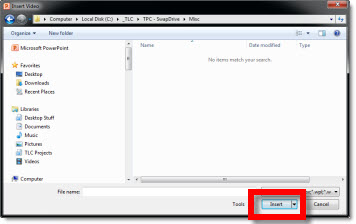
Inserting a video with PowerPoint 2010 starts the same as PPT 2007. Insert >> Video >> Video From File.

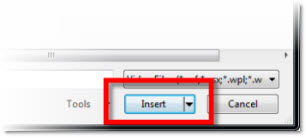
And we still get the same dialog window to choose the video to insert. But the drop down menu is now very important.

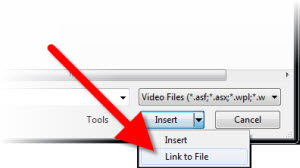
If ‘Insert’ is selected the video will be embedded.

If ‘Link to File’ is selected it will be linked to an external file.

Note: find and select video first, then use the Link dropdown because selecting the dropdown is the same as clicking it.

– Troy @ TLC

By |2016-08-16T11:36:34-07:00May 12th, 2010|Tutorial|

How To Fix The Gap in Text Reflections

Selective use of the reflection tool for text can make slide layouts very dynamic. But why does the upper text have a gap and the lower text does not?

There are 3 preset gap options, but both samples here have the same setting (zero gap).

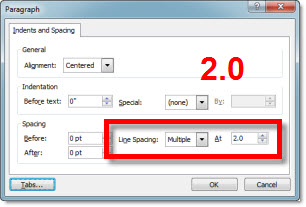
The answer is the line spacing is different. The larger the line spacing the larger the reflection gap – even when set to zero gap option. The top sample has a line spacing of 2.0, which creates a gap:

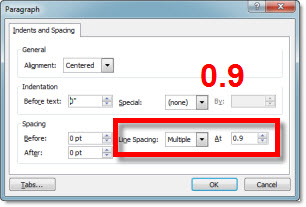
The lower text is setup with a .95 line spacing (note: 1.0, or single spacing, is the zero point for refections):

– Troy @ TLC

By |2016-08-16T11:47:30-07:00April 15th, 2010|Tutorial|

Animate Visual Dividers

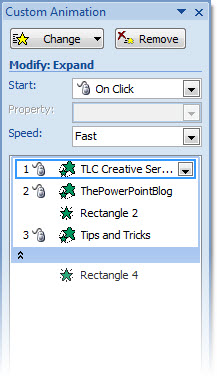
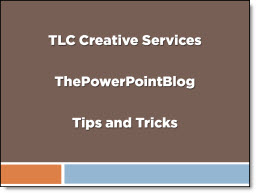
Using the previous post’s sample, here is how I set up the animation on the slide.

Here is the sample slide:

Here is the Animation Pane for the slide:

1. Text Box = Entrance animation – Expand – On-click (for each level) – Fast
2. Divider Lines = Entrance animation – Fade – With Previous – Fast
3. Drag 1st lines animation under 2nd line (2nd animation). So it fades in as the 2nd line of text expands.

Done!

The animated sample slide can be downloaded here (47K ).

– Troy @ TLC

By |2016-08-16T11:55:25-07:00March 28th, 2010|Tutorial|

Gradient Visual Dividers

Lots of slides have a few main points, like this example:

I like to add a simple divider line as a visual break between each line. And I create it in PowerPoint using a simple gradient fill. So my sample slide looks like this:

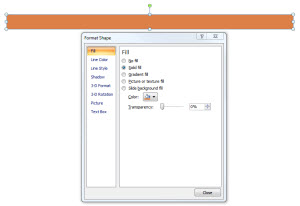
To create the divider line, start with added a basic rectangle – no outline and the fill color you want.

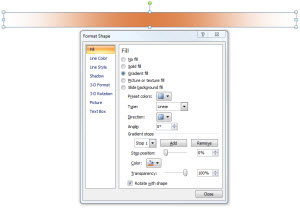
Then change to a Gradient Fill.

Creating the feathered edge is a bit tricky:
1. Type = Linear
2. Angle = 0
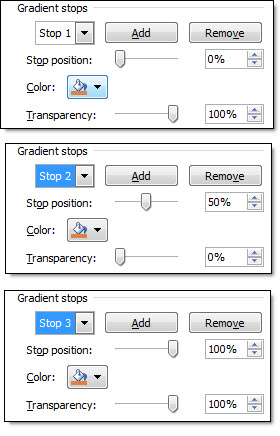
3. Stop 1: position = 0, color = your pick, transparency = 0
4. Stop 2: position = 50, color = your pick, transparency = 100
5. Stop 3: position = 100, color = your pick, transparency = 100
** Delete any additional stops (only want 3)

Last, adjust the rectangle height to be smallest possible.

Done!

– Troy @ TLC

By |2016-09-16T08:55:31-07:00March 26th, 2010|Tutorial|

3D Star Sample

For a recent project I needed some eye catching callouts/starbursts. I created a series of 3D stars and overlayed text boxes with the key phrases (New, Now, Available, etc.). It was a quick solution that looked really nice.

I started with a simple Star autoshape.

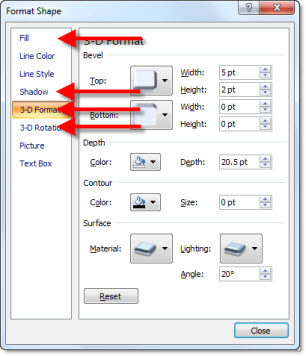
Adjustments to several tabs of the Format Shape box was all that was needed to create the visual.

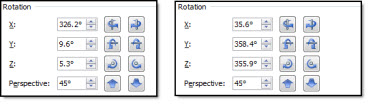
One of the tricky adjustments is changing the perspective to have a left facing star and a right facing star. Only 2 tabs are needed. The Shadow tab, adjusting the Angle and the 3D Rotation tab. Compare the numbers on the Rotation tab.

You can download a slide with these 3D stars on it here (33k ).

– Troy @ TLC

By |2016-08-16T11:56:19-07:00March 24th, 2010|Portfolio, Tutorial|

Zoom and Pan Animation Sample (Hockey)

Living in Southern California, Hockey is not really a focus for me. But with the excitement of the Winter Olympics hockey match up I was inspired to create this animation example. A popular animation effect used in recently (especially in commercials) is a zoom and pan where the background stays in place and key elements slowly lift and move to create depth and motion from a static image. The effect is not difficult in video or PowerPoint, it just requires a lot of prep work.

Here is my original image:

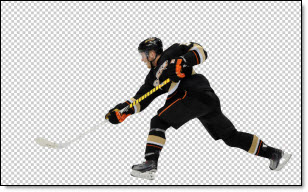
In Photoshop I dropped out the background and saved it as a .png:

I also created a background only version in Photoshop, where I ‘erased’ our hockey player from the image:

Then in PowerPoint I inserted 2 images; the hockey player and the blank background. Then applied the zoom and pan animation (grow/shrink 120% and motion path) to the hockey player image.

The result is a subtle motion to the slide that adds a nice polish and depth to what would be just a standard slide. Download the sample slide here (1.14MB ).

– Troy @ TLC

By |2025-01-02T13:35:51-08:00March 20th, 2010|Tutorial|

Customize an Image With Recolor

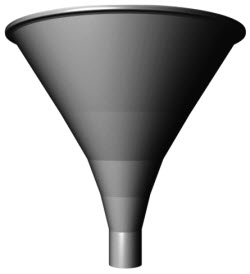
The recolor feature (FORMAT >> RECOLOR) can customize an image, saving a trip to Photoshop. For this presentation I needed to use the same content in 3 color coded sections. Once the funnel image was optimized and saved from Photoshop as a .png with no background I was able to do the rest in PowerPoint. Here is my original, simple greyscale funnel.

And here the funnel on 3 slides – no grey.

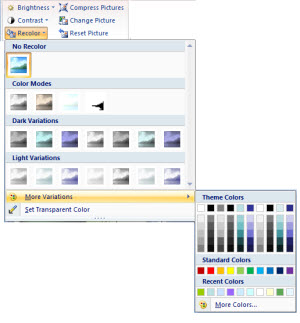
The funnel image used the custom color recolor:

The bars use a 2 color gradient fill with just color 1 adjusted (color 2 = white and 100% transparent).

Download the sample presentation to see the recolor tool in use (129K). Note: if your browser changes downloaded file to”.zip” rename to “.pptx”.

– Troy @ TLC

By |2016-08-16T11:59:17-07:00March 10th, 2010|Portfolio, Tutorial|

Color Swatch Add-In (for Templates)

If you develop PowerPoint templates, this new add-in from OfficeTips (PowerPoint MVP Shyam Pillai) is a MUST HAVE. Adding a custom color scheme is a tedious process that is now super easy, just fill in the swatches with the colors needed for the template, click apply, done!

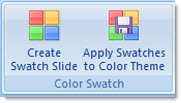
Install the free ‘Color Swatch’ add-in (PPT 2007, 2010) and it adds these 2 options to the ribbon:

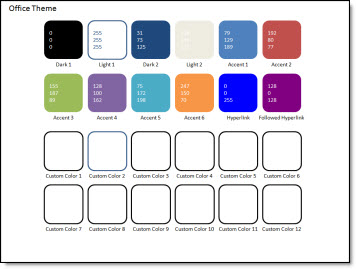
Click ‘Create Swatch Slide’ and this slide is added to the presentation:

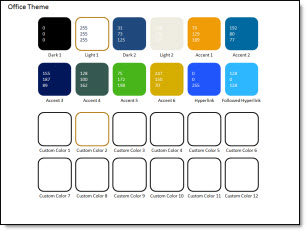
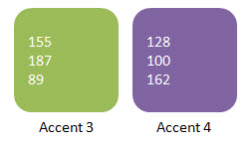
Simply change the fill color to all boxes as needed for the template custom color scheme. Here I have created a blue/green color pallette (leaving the first 4 boxes the same):

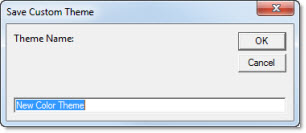
With the colors set click ‘Apply Swatches to Color Theme’ and give the color scheme a name (which will show up in DESIGN >> COLORS):

When applied the RGB value for each color swatch is updated automatically!

But wait, there’s more!

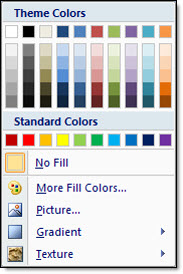
Here is a standard color pallette. It shows theme colors, MS standard colors, and additional options:

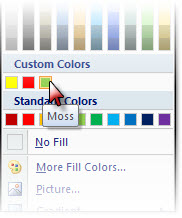
Maybe you have seen a corporate template another section called ‘Custom Colors’. PPT can pin additional colors to a theme, but up until now it involved xml coding with no visual interface to get these often needed colors into the template. Now it is as easy as applying a fill color to some boxes!

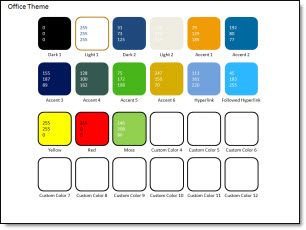
Here I have updated the Swatch slide with 3 custom colors. I have also named them (Yellow, Red, Moss).

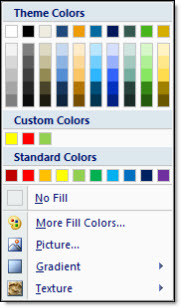
Now when I look at the color pallette I have a new row of colors. And the Custom Color row travels with the presentation:

And the tooltip shows the color names assigned:

WOW!! This is a really, really incredible (and if you don’t develop templates, trust me, this is incredible!). Here is the info and download page.

– Troy @ TLC

By |2016-09-16T08:57:26-07:00March 8th, 2010|Tutorial|

Template Note on PPT 03 vs 07

This great tip is from MS PPT MVP Sandy Johnson at The Presentation Wiz. In talking about developing presentation templates Sandy mentioned a disclaimer type slide she includes at the beginning of all templates to help the user understand there are some challenges in using PPT 2003 templates in PPT 2007 and vice-versa.

Here is the slide included in her templates:

This template has been created in PowerPoint 2003 and is designed to utilize 2003 design features. While presentations created using this template can be viewed in PowerPoint 2007, note that if our presentations are edited in 2007, some of your Slide Master features will be lost.
To that point, we strongly encourage the PowerPoint template best practice of always starting new presentations with a “fresh” Slide MASTER template (vs. reusing an old presentation).
Thank you.

This is a great idea and service to everyone that uses the template. Look for a various to be included in all of my PowerPoint templates from now on.

– Troy @ TLC
By |2016-09-16T08:55:03-07:00February 25th, 2010|Tutorial|

Superscript with Keyboard Command

If using PPT 2007, you may have found the super and subscript buttons missing from the ribbon. My first solution is to make use of the QAT (Quick Access Toolbar) and add these valuable tools to it.

But you can also make any text superscripted with a keyboard command.

This works in PPT 2007, 2003, XP, and 2000 (cannot remember if works in PPT 2000, so this is just a guess).

A few notes about using the keyboard options from my use and observations:
1. PPT 2003 CTR+SHIFT+(plus) superscripts. Do it again and it returns to
standard text.
2. PPT 2007 CTR+SHIFT+(plus) superscripts. Do it again and nothing happens
(eg. no way to return to standard text from keyboard commands).
3. I have never been able to use keyboard command in either version to sub-script text (although others have said it works).

By |2016-09-16T09:03:38-07:00February 2nd, 2010|Tutorial|
Go to Top