
Can a Mobile Device Project? Yes it can!
There is a lot of talk and excitement about using mobile devices, phone or tablet, to run presentations. And yes, I can confirm it is possible. But the question is – should you use a tablet or smartphone as the presentation “computer?” The answer – it depends on the meeting.
Some presentations require a mobile device, such as a mobile app demo. But for a traditional presentation, if it is a large meeting with AV support, I recommend conforming to the desktop app and handing off a presentation file. This ensures you can focus on the presentation, not the technology setup and function. If it’s a small board room meeting and you feel confident in using newer technology, then mobile devices can be a good option. However, I recommend having a traditional computer, and the presentation on a memory drive – just in case.
Let’s look at the different options currently available to work with when it comes to using mobile devices in presentations. This is a high-level reference and overview of the primary mobile devices that can be used for presentations.
Apple
- iPhone, iPad Tablets and iPod Touch
- Android Phones and Android Tablets
Microsoft
- Windows 8.1 / 10 Mobile and Surface Tablets
Wired and Wireless
There are two types of connection options for getting a presentation from a device to the projector. Both are options. In general, using a wired connection is going to be easiest option, as it has the least technology needs (do to the cables, connect – done).
Wired
The first option is wired connections. This is (obviously) physically connecting a cable to the mobile device. Each device type has a different connector, and then there are multiple options for the AV system you need to figure out (eg. Is the AV system using VGA, HDMI or other display connector?).
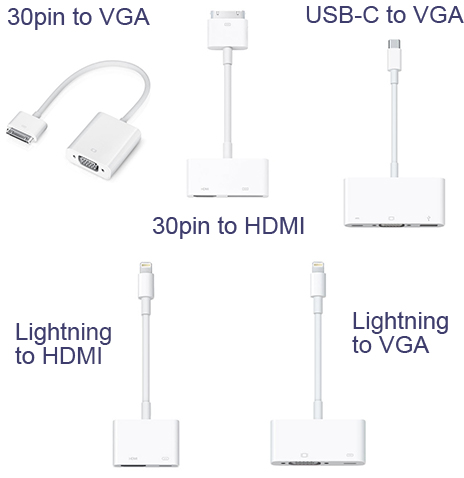
iPhone/iPad Connectors
- 30 pin to VGA/HDMI
- Lightning to VGA/HDMI
- USB-C to VGA
Android Phone / Tablet Connectors
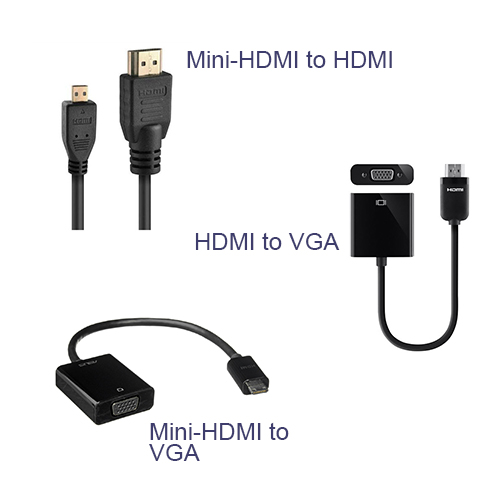
- Mini-HDMI to HDMI or VGA
- HDMI to VGA/HDMI/DVI
Windows 10 Phone / Tablet Connectors
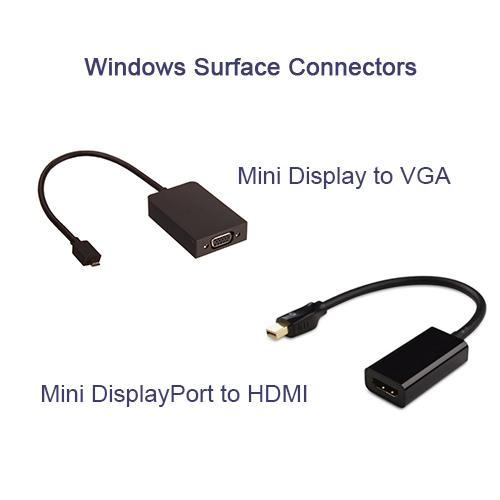
- Mini HDMI to HDMI/VGA
- Mini DisplayPort (AKA Thunderbolt) to HDMI/VGA/DVI
Wireless
The second option is connecting your mobile devices using a wireless system. Keep in mind, most wireless display connectors need WiFi. And the WiFi needs to be fast enough for the presentation to display content and animations smoothly, and it needs to have enough coverage to connect in the meeting meeting room (ie. Not your hotel room or the lobby, but the actual ballroom). Miracast is a direct connection technology, so a WiFi network is not needed.
iOS Devices = Apple TV
Apple devices are easily the most popular and abundant (myself included with an iPhone and iPad). Apple devices need to connect to Apple TV, so you need the physical Apple TV device and a WiFi network for both the IOS device and Apple TV connect to (then the Apple TV connects to the AV System/projector/monitor). AirPlay is the IOS app (built in to all Apple devices) that make the wireless display work.
My opinion on wireless presentations from IOS devices is that they work well, but have a lot of hardware and setup needs.
Android Devices = Google Chromecast
If you use an Android mobile device, the Google Chromecast device is needed. The original Chromecast device was basically a small USB drive with an HDMI connector and additional mini-USB port for power. The new Chromecast device is a bit larger, more in line with an Apple TV size (but still just a USB power). Another option is many SmartTVs are Chromecast-ready and Android devices can stream direct to it with no additional hardware. No matter what Chromecast connector is used, WiFi is needed.
Last, if you are using an Android device, a great app available in the Android Google Play App Store is AllCast, which enables Android devices to also connect to Apple TV, even more SmartTVs and the Amazon Fire TV.
My opinion on Chromecast is that it works, has smaller equipment, has easy setup – but I have been unable to connect it to some larger show AV systems…
Windows 10 Mobile = Miracast WiFi
If you’re a Windows 10 Mobile device user, or Windows 10 desktop, the MiraCast wireless display software is built in. The interesting thing (and good thing), is MiraCast is not a Microsoft technology, but an industry wide wireless display platform that Microsoft has adopted and integrated into ALL Windows 10 devices (Note: It is also available on Windows 8.1 as a download in the Windows App Store). MiraCast is also available on Android devices as a separate app download, and it also works with IOS devices (but is not available through the Apple App store, so only works with “jail break” devices which I hope changes in the future).
My opinion of MiraCast is this works the best of all wireless display options covered. Because it is an open standard, the physical dongle is not limited to one company and I have had some work great and others not work at all. I recommend the Microsoft manufactured device as I have had flawless operation of it (and it is very small like the original Chromecast device). The other really great feature is that MiraCast does not need WiFi, it will connect to any device using a local connection (so it does use WiFi, but not internet enabled WiFi).
I hope the helps with an overview of many mobile device connection options and some of my (sometimes hard-earned) opinions on mobile devices for presentation use.
-Troy @ TLC
What is Rear Projection?
When designing a presentation, the design can be influenced by many technical specifications. One consideration is where the projected light is coming from (ie. Front or Rear Projection).
“Rear Projection” is literally what the name says – the projector is positioned behind the screen.
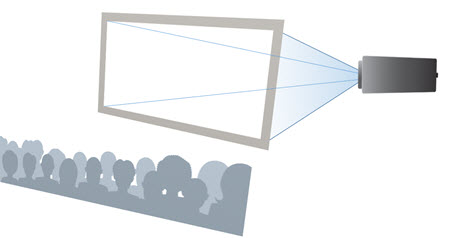
Here are some of the design considerations for meetings that are setup with Front Projection:
- The audience cannot see the projector, and there are no cables to trip over or tables to bump (at least out front where the audience is).
- In general, Rear Projection is the “professional” setup.
- Rear Projection, assuming the other specs are the same (projector lumens, screen size, room lighting, etc.), is a bit duller to an audience than Front Projection because the slides are being projected through the screen material.
- With Rear Projection, the audience can see a “hot spot” because the audience is looking into the projector light. If the projector is at the same eye level, the audience can see a bright circle or the projector light. The solution is to have the projection be above the audience eye level (all the way on the ceiling is great) and to have it adjusted to fit the screen and keep aspect ratio.
-Troy @ TLC
What is Front Projection?
When designing a presentation, the design can be influenced by many technical specifications. One consideration is where the projected light is coming from (ie. Rear or Front Projection).
“Front Projection” is literally what the name says – the projector is positioned in front of the screen.
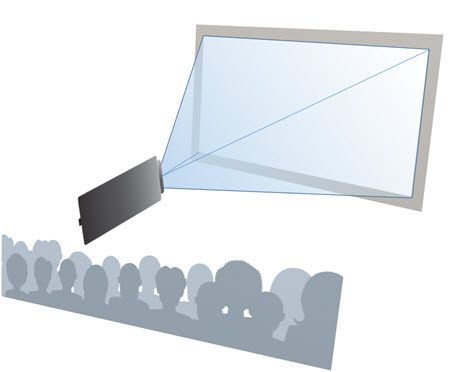
Here are some of the design considerations for meetings that are setup with Front Projection:
- If the screen is directly behind the stage and presenter, the presenter may stand in the projection and be “painted.” This will cast the presenter’s shadow on the screen.
- Front Projection, assuming the other specs are the same (projector lumens, screen size, room lighting, etc.), is brighter to an audience because the slides are being projected onto a brighter white screen material and the image is bouncing off from the screen.
- CAUTION: Be extra attentive to content not being too close to the edge of the slide. Front Projection is often “over shot.” By making the projection area slightly larger than the white screen space, it assures the full screen is filled with an image. If the slides have a logo at the very edge, footnotes along the very bottom, etc., they will be cut off to the audience because they are being projected in the over shot area that is not seen.
-Troy @ TLC
Use a PDF for a Slide Show
A PDF of slides, or any document if in the correct aspect ratio, can be used for presentation slides. I am using Adobe Acrobat, but most PDF viewing apps have the same capability.
Here is my sample 16×9 presentation of 4 slides exported as a PDF, now open in Acrobat.
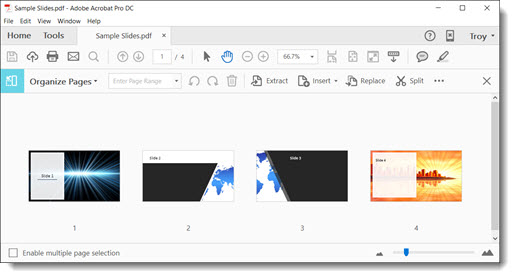
I have selected the first page vs. the Organize/Grid view.
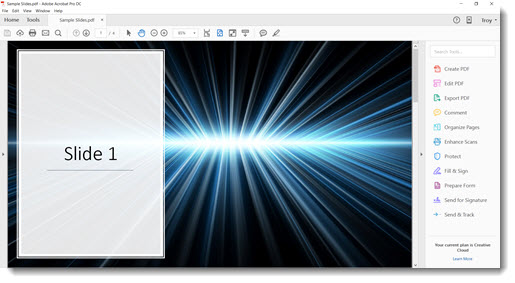
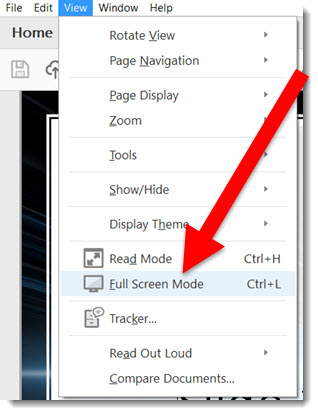
Go to VIEW > FULL SCREEN MODE, or use the keyboard shortcut CTRL+L
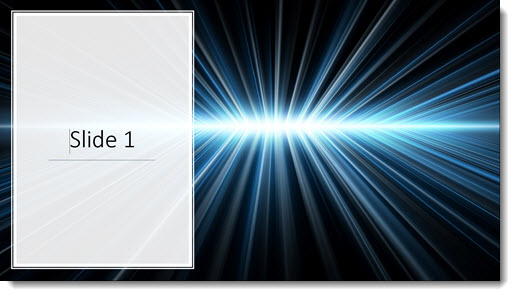
The Acrobat tool bars disappear and the slide displays full screen. Using the arrow keys or Page Up/Down keys, you can go through the pages just like a presentation.
Notes:
- No animation
- No slide transitions
- No video or audio (There are ways to add these, but not covered in this tutorial, and not part of PowerPoint’s PDF export)
- Cannot be added to a master slide deck of all presenter slides (This is a separate file that just look like slides)
- No presenter view (Duplicate display is recommended vs. extended desktop)
-Troy @ TLC
What about LED wall “projection”?
LED walls are becoming the new standard for displaying video and presentations. The viewing quality of a build-to-any-size LED wall is already great, and they continue to get better! These screens have a resolution that is the same concept as projectors having resolution, their resolution is visible, it is the physical space between each light pixel. The closer/tighter the light spacing, the higher the resolution.
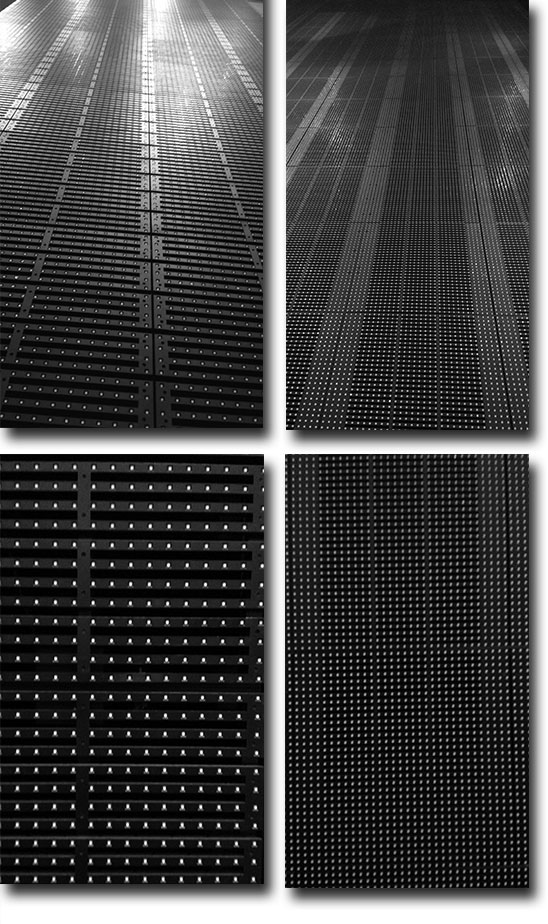
But projectors and LED walls measure light and brightness differently. Projection = lux, reflected light. LED = NIT, direct light. What does this mean? It means that LED walls, like flat panel displays, are brighter, which is great for slides!
Plus, LED walls are like Lego blocks, they can be built into any shape and aspect ratio. This leads to some fun and creative PowerPoint templates! For example, these are LED walls that used a single, custom, PowerPoint template for their content.
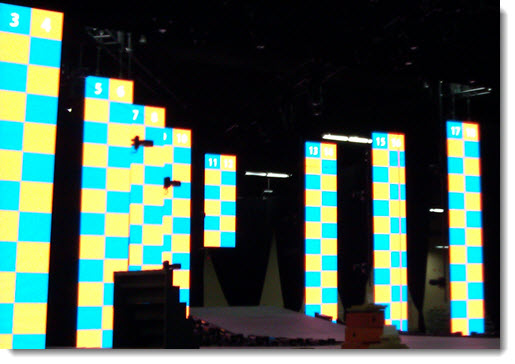
An LED wall can be a great option for presentations.
-Troy @ TLC
US Letter Size PowerPoint Template (Free!)
As promised in Episode 6 of The Presentation Podcast , Print Only Presentations (which actually releases tomorrow), here is the PowerPoint template setup in US Letter 8.5 x 11″ Portrait size. All layouts have been customized to fit the letter size page plus a few additional layouts using multi-column text boxes!
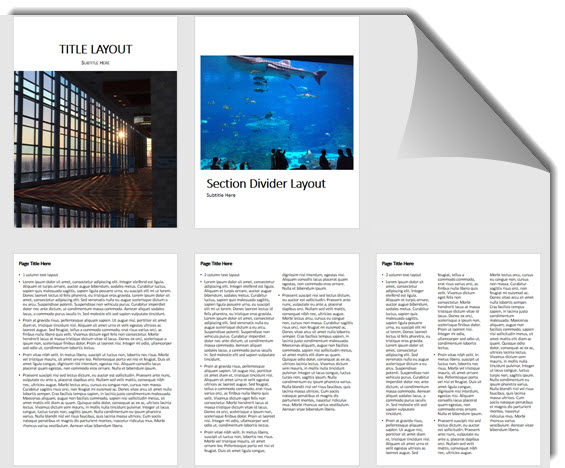
To download the template, click here (330K).
-Troy @ TLC
Text Aliasing and Anti-Aliasing
Picking a font style is important. Should it be a “safe” font, a professional font, a bold font, etc.? Any font style needs to display well and anti-aliasing is a big part of that. So, what is anti-aliasing?
The simple description of anti-aliasing is that it makes fonts display with smooth curves and angles, not jagged, low res looking edges. So if “anti-aliased ” is smooth, the opposite, hard edged fonts would make sense to be called “aliased.” However, the better term is “bit-mapped.”
Here’s a visual showing Aliased and Anti-Aliased Text:
Aliased (Jagged, Hard Edges):

Anti-Aliased (Smooth Edges):

The good news is PowerPoint applies anti-aliasing to text (which has not always been the case). But it is applied when in slide show. Objects and text may appear to have jagged edges (aliased) when editing. Anti-aliasing is also applied when printing, but through a different ‘engine’ than when presented. So, when running as a slideshow, everything is smooth, when printing, everything is (almost always smooth), when editing, it may not look as smooth.
In addition, Microsoft Windows OS has its own term and feature for anti-aliasing called ClearType. ClearType is basically Microsoft’s technology for doing anti-aliasing and making fonts have nice smooth curves and angles. ClearType is currently used by web browsers (all web browsers) and the operating system dialogs. But not Microsoft Office at this time.
On PowerPoint, when using the PowerPoint web app it is viewed through a browser for editing and slideshow. So, all text is anti-aliased in both views because the Microsoft ClearType works with all major web browsers.
So, should you be worried about anti-aliasing or smooth fonts with PowerPoint? Yes, it is a concern, but with Windows 10 and PowerPoint 2007-2010-2013-2016 all fonts display anti-aliased in slideshow – and I can attest to being happy with text that is projected 20′ tall is HD is smooth and looks good (with the caveat that there is room for it to be better!).
-Troy @ TLC